


Capital Requirement: Ensuring Financial Stability

Discover at Pirani how the capital requirement works, now you can automatically calculate your exposure to operational risk with a standardized approach. Request it now.

stars_capterra-Piranig2-logo-gris| capterra-logo-gris  + 350 reviews

1-capital-requirement-pirani

What is the Capital Requirement?

The Basel Committee on Banking Supervision (BCBS) has established that financial institutions must maintain a minimum level of their own funds to cover the inherent risks in their activities and ensure the financial stability of the system. This capital acts as a safety cushion that allows banks to absorb losses during crisis times without compromising their solvency or affecting public confidence.


2-capital-requirement-pirani

Why is complying with the Capital Requirement mandatory?

Complying with the capital requirement is mandatory for financial institutions due to several key factors that ensure the stability of the financial system:

Ensuring the solvency and stability of institutions

It ensures that institutions can face unexpected losses without compromising their operations during periods of economic crisis.

Protecting depositors and clients

Adequate capital is fundamental to protect clients’ funds, especially in times of economic uncertainty.

Complying with international regulations

Alignment with the global standards set by Basel is essential to maintain the competitiveness and regulatory compliance of the institution.

Reducing systemic risk

Adequate capital prevents the failure of a single institution from endangering the entire financial system.

Protecting the national economy and the stability of the system

It ensures that financial institutions remain sustainable and contribute to long-term economic growth.

Operational events: a fundamental pillar for capital calculation capital

Isabella-Campo-firma
Let's talk
Discover how to obtain capital requirement
Schedule a demo

Los mejores confían en nosotros:

Capital requirement models

Simplificación y adaptación a las normas internacionales

El modelo SMA (Standardized Measurement Approach) es el enfoque recomendado bajo Basilea III y IV para calcular el requerimiento de capital por riesgo operacional. Este modelo simplifica la implementación de la regulación y está diseñado para facilitar su aplicación en entidades financieras de diversos tamaños, ajustando el capital en función de la actividad económica y los eventos operacionales que haya experimentado la entidad.

3-requerimiento-capital-sma-lp

¿Tu entidad financiera está preparada para cumplir con los requisitos de capital según el Modelo SMA?

Asegura el cumplimiento normativo y fortalece la solidez financiera de tu banco o cooperativa.

Solicita más información o agenda una demo aquí 👉

  
SMA Model

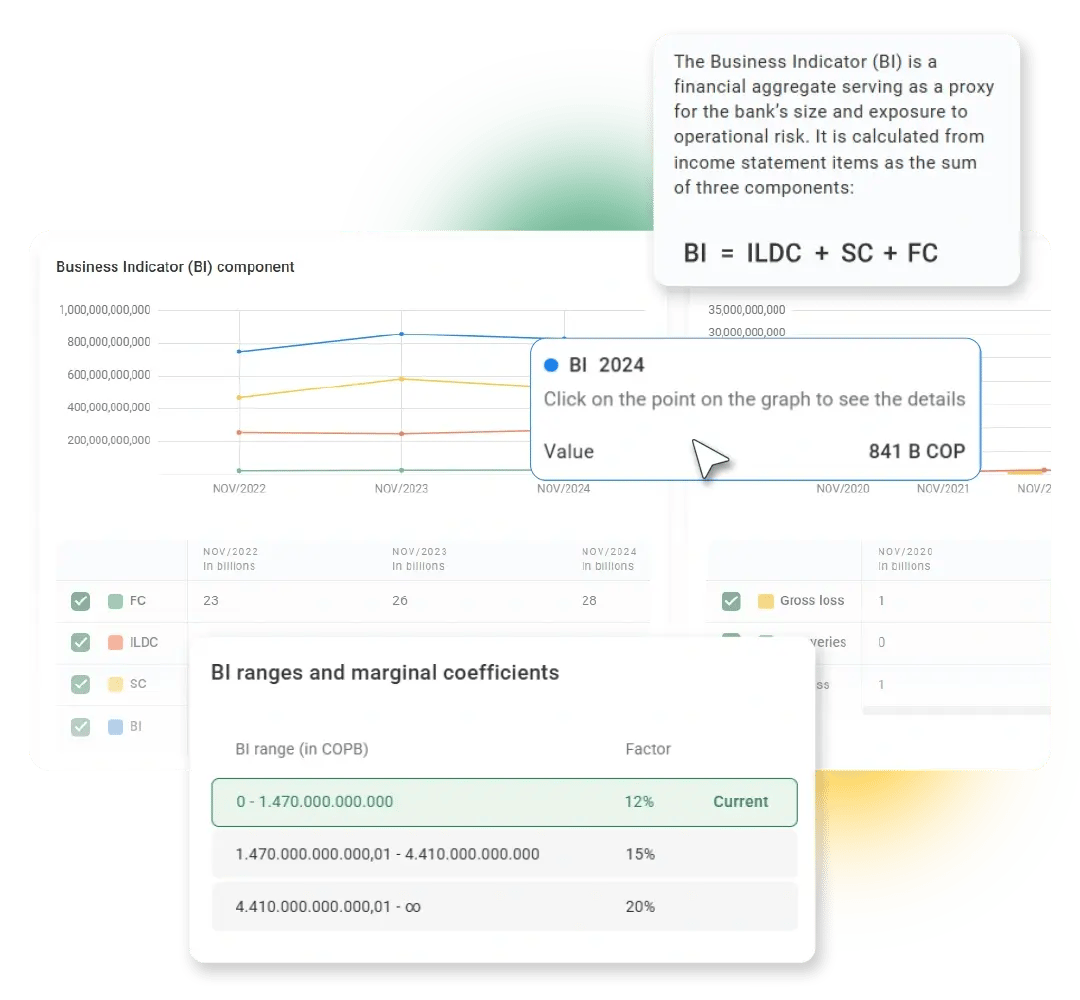
Capital requirement calculation under the SMA model (Basel III)

Simplification and adaptation to international standards

The SMA (Standardized Measurement Approach) is the recommended approach under Basel III and IV to calculate the operational risk capital requirement. This model simplifies regulatory implementation and is designed to facilitate its application in financial institutions of various sizes, adjusting the capital based on economic activity and operational events experienced by the institution.

3-capital-requirement-sma-pirani
4-capital-requirement-sma-model-pirani

Configurability and flexibility

Pirani implements the SMA model in a flexible way, allowing institutions to adjust calculation parameters such as BIC (Business Indicator Component) and ILM (Internal Loss Multiplier). This ensures that each institution can adapt to local regulatory requirements and optimize their capital reserves according to their specific characteristics and needs.

Benefits of the SMA model

1. Simplicity and clarity

The SMA model provides a standardized and easy-to-implement approach to calculate the required capital, which facilitates efficient and transparent operational risk management.

2. Adaptability

This model can be applied to a variety of financial institutions, allowing adjustments based on the institution’s loss history and activity volume — without compromising calculation accuracy.

3. Compliance with Basel III

Adopting the SMA model ensures that your institution will align with international regulations, protecting its reputation and ensuring global competitiveness.

4. Greater financial resilience

A more precise calculation of the necessary capital enhances the institution’s financial resilience in the face of economic crises and unexpected adverse events.

How the SMA model impacts your institution

5-capital-requirement-model-sma-lp-pirani

1. Ensures regulatory compliance

Complying with the Basel III SMA model ensures that your institution aligns with international regulations, protecting its reputation and securing its global competitiveness in the financial market.

4-capital-requirement-sma-model-pirani

2. Improves risk management

The SMA enables more efficient management of the capital required to cover operational risk, reducing exposure to unexpected losses.

2-capital-requirement-pirani

3. Increases investor confidence

Institutions that adopt this model provide greater assurance to clients and investors by demonstrating that they are well prepared to manage operational risk.

Isabella-Campo-firma
Let's talk
Discover how to obtain capital requirement
Schedule a demo
  
BIA Model

Capital requirement calculation under the BIA model (Basel II)

The BIA (Basic Indicator Approach), defined by Basel II, is the simplest approach to calculating the operational risk capital requirement. It is based on a single indicator: the average gross income over the last 3 years.

Capital Requirement (ORC) = 15% × Average Gross Income (3 years)

6-capital-requirement-model-bia-pirani-lp

Benefits of the BIA model

1. Simplicity and speed

Does not require advanced models or data segmentation: ideal for organizations in early stages or with basic accounting infrastructure.

2. Regulatory compliance guaranteed

Fully aligned with Basel II standards and current local regulations.

3. Agile implementation

With Pirani, you can configure and automate the capital requirement calculation.

4. Scalable toward Basel III

The BIA model is a solid foundation for future transition to more advanced models such as SMA (Basel III).

How the BIA model impacts your organization

Adopting the BIA model allows you to:

  • Comply with regulation without operational complexity.
  • Gradually strengthen operational risk management.
  • Establish a base structure that can evolve toward more advanced models.

7-capital-requirement-model-bia
  
TSA Model

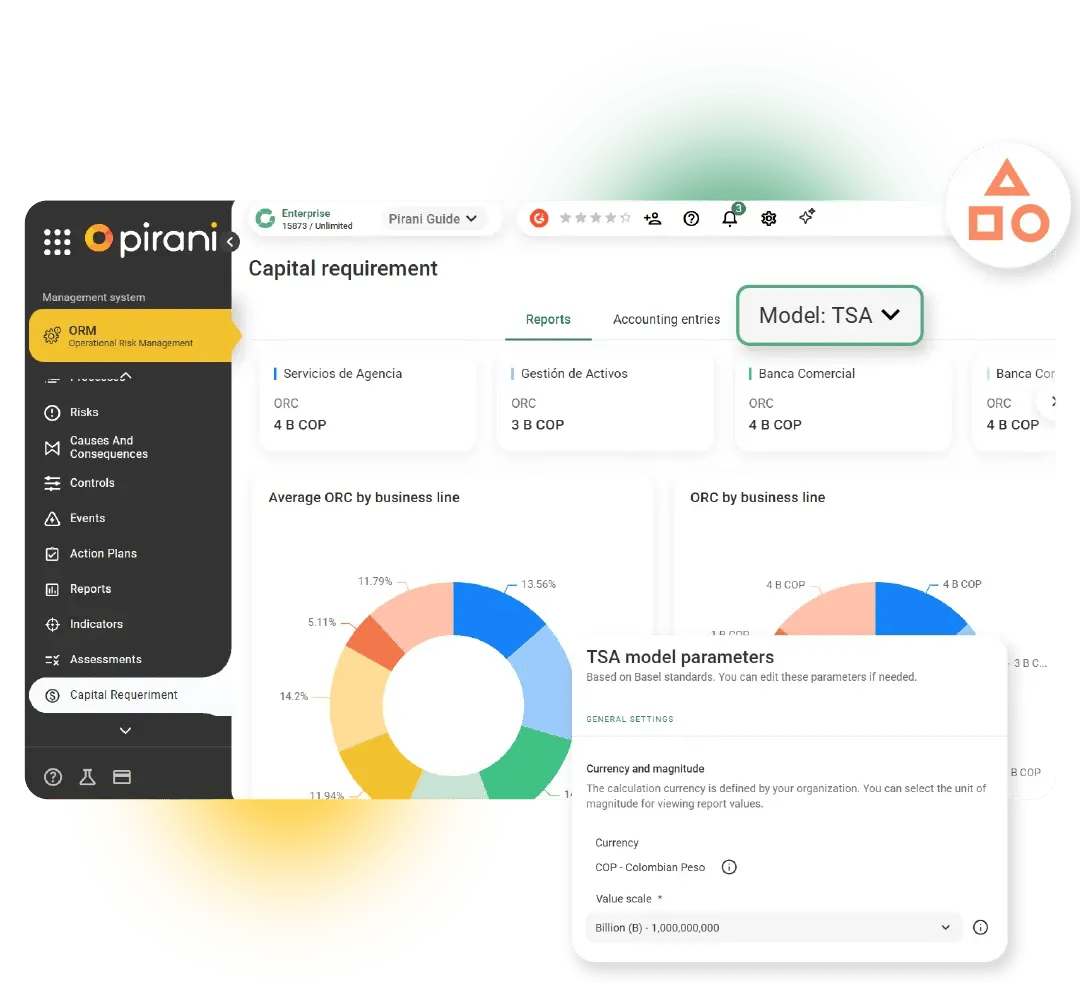
Capital Requirement calculation under the TSA Model (Standardized Approach)

Transition toward a more detailed and segmented measurement of operational risk

The TSA (The Standardized Approach) allows calculating the operational risk capital requirement by assigning different percentages to the gross income of each business line. Unlike the BIA model, TSA recognizes that not all activities have the same level of risk, and adjusts the required capital accordingly.

8-capital-requirement-model-tsa
9-capital-requirement-model-tsa-pirani

What is the TSA model?

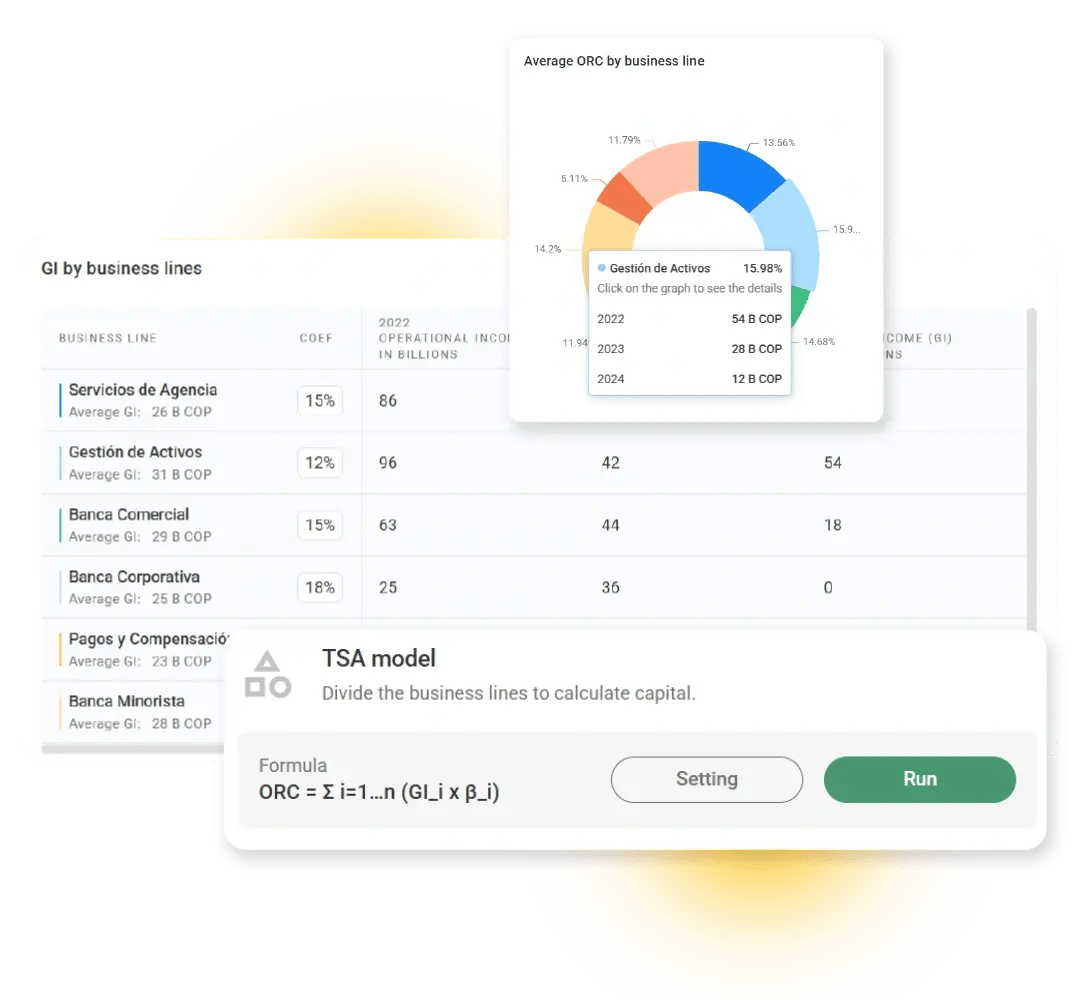
The TSA (The Standardized Approach) is a Basel II methodology that calculates the capital requirement by applying different operational risk coefficients (from 12% to 18%) to the gross income generated in eight defined business lines.

ORC = Σ (Gross Income of Business Line × β)

Each business line (such as retail banking, corporate banking, payment services, etc.) has a defined operational risk factor according to its exposure to risk.

Benefits of the TSA Model

Greater precision in measuring operational risk

By breaking down by business line, you get a more granular and representative view of actual risk.

Better alignment with organizational structure

Allows institutions to analyze and optimize capital assigned by business unit.

Improved regulatory compliance

Serves as a natural evolution from BIA, accepted by many regulators as an intermediate step before the SMA model.

Solid foundation for implementing more advanced models

TSA is a good intermediate stage between simple approaches (like BIA) and sophisticated ones (like SMA), aiding maturity in risk management.

How the TSA model impacts your organization

Implementing the TSA model enables you to:

  • Identify which business units generate the highest operational risk exposure.
  • Provide an ideal bridge toward standardized and advanced measurement models (like SMA).
  • Align your accounting and revenue structure with international best practices.

10-capital-requirement-model-tsa-pirani

We don't say it ourselves, we are backed by the best:

Nueva llamada a la acción
“It is an easy to understand software that guides you to carry out the business risk assessment, the process to follow and to implement the control measures that mitigates risks.”
David C.
Compliance officer
"Pirani allows mapping risks in an easy way and having the relation between them and the causes, consequences and controls. The system is very complete."
Maria M.
Operational Risk Analyst

Frequently asked questions

What types of organizations does the Capital Requirement feature apply to?

The Capital Requirement feature can be used by any organization, whether or not they are subject to a specific regulation — or choose to apply it as a best practice in risk management.

Whether the need to calculate capital requirements is driven by regulatory demands (as in financial institutions, insurers or cooperatives) or by internal responsible management oriented to sustainability — this feature offers a flexible framework adapted to different organizational contexts.

From which plan is it available?

The Capital Requirement functionality is available from the Starter plan onwards. To activate it, it must be specifically requested, as it is not included by default in accounts. Schedule a demo now.

Additionally, all clients have the possibility to explore this functionality from the DEMO version. If you are already a client, you can access the “Explore demo” option to test and get familiar with the module’s capabilities before formal implementation. This is an excellent way to evaluate its usefulness within your risk management system.

Do I need to have my events registered?

Yes. To correctly calculate the operational risk capital requirement, it is essential that all risk events are registered in the official system.

Only events that have been reported, verified, and certified according to the country’s regulations — generally by regulatory authorities — are considered valid.

Registering and certifying your risk events allows you to:

  • Comply with regulatory requirements.
  • Ensure traceability and quality of the information used in capital models.
  • Feed internal risk measurement models accurately and reliably.
  • Support possible requests for additional capital under adverse scenarios. 
⚠️ Important: Events that are not properly registered and certified cannot be considered for the capital requirement calculation.

Does Pirani help companies obtain event certification?

Yes. Pirani facilitates the process for companies to certify their risk events by ensuring that minimum necessary controls and requirements for proper validation are met.

The platform ensures correct classification of events, precise chronological management of dates and relevant milestones, and a structured and detailed record of losses associated with the event.

For example, Pirani helps to document and track key fields such as:

  • Accounting date of the event.
  • Amounts involved in losses or impacts.
  • Dates of occurrence and detection of the event.
  • Classification of risk type (fraud, operational error, technological failure, etc.).
  • Description and evidence associated with the event.

These controls are essential for complying with the requirements demanded by regulators in each country and thus obtaining official certification of the reported events.

Are accounting entries necessary?

Accounting entries — whether entered manually or via bulk upload — are fundamental to correctly execute the capital requirement calculation model.

These entries feed the model with the historical financial data needed to:

  • Estimate past losses and future projections.
  • Determine the required capital to cover risks associated with the business operations.

The model performs the calculation of the capital requirement considering a horizon of:

  • 3 years for the business component.
  • 5 or 10 years for the loss component, depending on data availability.

Therefore, it is key to have complete, accurate, and up-to-date accounting entries, since they directly impact the final result shown in the capital requirement report, which serves as the official reference for presentation and decision-making.