

In 2026, many organizations in North America will discover that their most serious operational failures did not start internally.
They started with a vendor.
Cloud outages, payment processor disruptions, software vulnerabilities, data breaches, and service interruptions are increasingly originating outside organizational boundaries. And regulators have made one thing clear: outsourcing services does not outsource accountability.
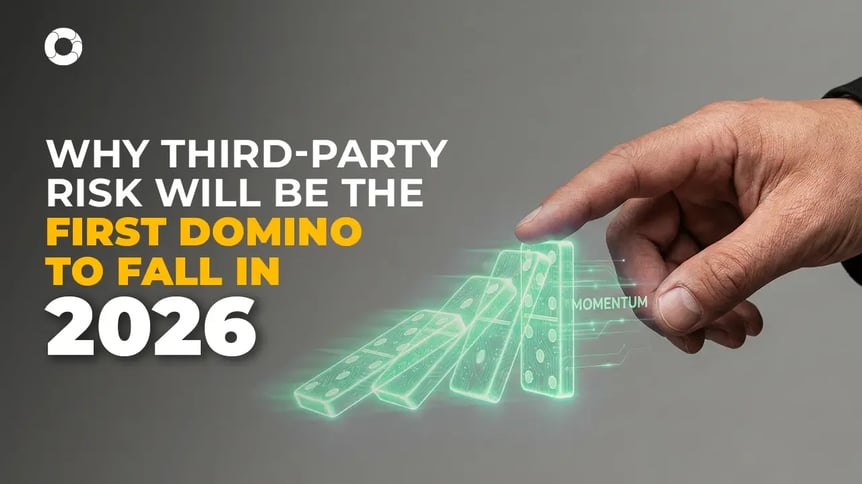
This is why third-party risk is emerging as the first domino to fall in 2026—and why it will trigger cascading regulatory, operational, and legal consequences across industries.
The illusion of outsourced risk
For years, third-party risk management in North America was treated as a procurement or compliance exercise. Due diligence questionnaires were completed during onboarding, contracts included standard risk clauses, and reviews were performed annually or biannually.
This approach was built on an implicit assumption: if a failure occurred at a vendor, responsibility could be mitigated by contractual distance.
That assumption no longer holds.
Regulators now assess third-party failures based on impact, not ownership. If a vendor outage disrupts critical services, compromises customer data, or impairs market integrity, supervisory scrutiny focuses squarely on the regulated institution—not the vendor.
This shift fundamentally changes how third-party risk must be managed.
Regulators are closing the accountability gap
In Canada, this change is explicit.
OSFI’s Guideline B-10 on Third-Party Risk Management establishes that federally regulated institutions remain fully accountable for outsourced activities, including those performed by subcontractors and fourth parties. Institutions must demonstrate continuous oversight, risk-based monitoring, and credible exit strategies for critical third parties
Crucially, B-10 does not treat third-party risk as static. It assumes risk evolves throughout the lifecycle of the relationship, requiring ongoing visibility into vendor performance, concentration risk, and systemic dependencies.
In the United States, regulatory expectations converge on the same principle.
The Office of the Comptroller of the Currency, the Federal Reserve, and the FDIC have jointly emphasized that banking organizations must manage risks arising from third-party relationships in a manner consistent with the risk and criticality of the activity, regardless of whether services are outsourced
Accountability follows function, not contractual form.
Why third-party failures cascade faster in 2026
Third-party risk becomes the first domino in 2026 because modern operating models are deeply interconnected.
Cloud service providers support core banking platforms, payment systems, and customer-facing applications. Fintech partners embed themselves directly into product offerings. Software vendors manage identity, fraud detection, and transaction monitoring. A single failure can propagate across multiple institutions simultaneously.
Regulators are acutely aware of this systemic dimension.
Supervisory guidance increasingly treats third-party risk as a matter of operational resilience, not vendor management. If an institution cannot demonstrate that it understands and controls its dependency on critical third parties, regulators view the organization as structurally fragile.
This is particularly evident in expectations around concentration risk and substitutability. Institutions are now expected to know not only who their vendors are, but whether they can realistically replace them under stress.

When vendors become critical services
A defining regulatory shift for 2026 is the reframing of vendors as part of critical service delivery.
Under operational resilience frameworks, institutions must identify critical operations—services whose disruption would cause intolerable harm to customers or markets. In practice, many of these services are delivered partially or entirely by third parties.
This creates a regulatory challenge: if a critical service depends on a vendor, then the vendor becomes part of the institution’s regulated perimeter.
Canadian guidance under OSFI’s E-21 and B-10, and U.S. supervisory priorities tied to operational resilience, increasingly expect institutions to map these dependencies and test their ability to operate through vendor failure.
Failing to do so exposes organizations to regulatory findings even if the vendor itself is compliant.
Fourth parties: the hidden risk regulators care about
One of the most underestimated aspects of third-party risk in North America is fourth-party exposure.
Many institutions have limited visibility into the subcontractors their vendors rely on—cloud infrastructure providers, data processors, software developers, and offshore service centers. Regulators are now explicitly asking for this visibility.
OSFI’s B-10 requires institutions to understand and manage risks associated with subcontracting arrangements. Similarly, U.S. regulators have emphasized the need for transparency into supply chain dependencies, particularly where critical services or sensitive data are involved
In 2026, “we didn’t know” will no longer be an acceptable response.
Why contractual controls are not enough
Many organizations assume that robust contracts are sufficient to manage third-party risk. Regulators disagree.
While contractual clauses remain important, supervisory expectations focus on operational evidence, not legal language. Institutions must demonstrate that they actively monitor vendor performance, test contingency plans, and can execute exit strategies if needed.
This includes scenario testing that assumes vendor failure, not just internal disruption. If an organization cannot show how it would continue delivering critical services during a major vendor outage, regulators increasingly treat this as a resilience gap.
Third-party risk management is therefore moving from documentation to execution.
What risk leaders must rethink now
The reason third-party risk will be the first domino to fall in 2026 is simple: it sits at the intersection of cyber risk, operational resilience, regulatory accountability, and systemic stability.
When a vendor fails, multiple risk domains activate simultaneously. Cyber incidents trigger disclosure obligations. Service outages impact customers. Regulatory scrutiny escalates. Legal liability follows.
Organizations that still manage third-party risk as a static compliance function will struggle to respond at this speed and scale.
Those that treat it as a strategic discipline—embedded into service design, resilience planning, and governance—will be better positioned to absorb shocks.
Looking ahead
In 2026, third-party risk is no longer a peripheral concern.
It is the fault line along which operational resilience, regulatory expectations, and ecosystem dependency converge.
The first major disruptions of the year are unlikely to start with internal failures. They will start with vendors—and they will reveal which organizations truly understand their operating model.
Because in the new risk landscape, the first domino rarely falls inside your walls.


The Silent Risk of 2026: Weak Risk Culture Drives Regulatory Findings
From Compliance to Resilience: 2026 Redefines Risk Management in Africa
From Cyber Incidents to Legal Liability: Risk in North America
2026: The Year Operational Risk Becomes a Survival Discipline
How Director Accountability Will Shape African Regulation in 2026

No Comments Yet
Let us know what you think