

In modern organizations, risk management and daily operations often exist in separate worlds. While risk, compliance, or security teams work on specialized platforms like Pirani, technical and operational teams manage their day-to-day activities using tools such as Jira.
The new Pirani-Jira integration represents a strategic step to bridge that gap, enabling a more connected, efficient, and transparent flow of information between operations and risk intelligence.
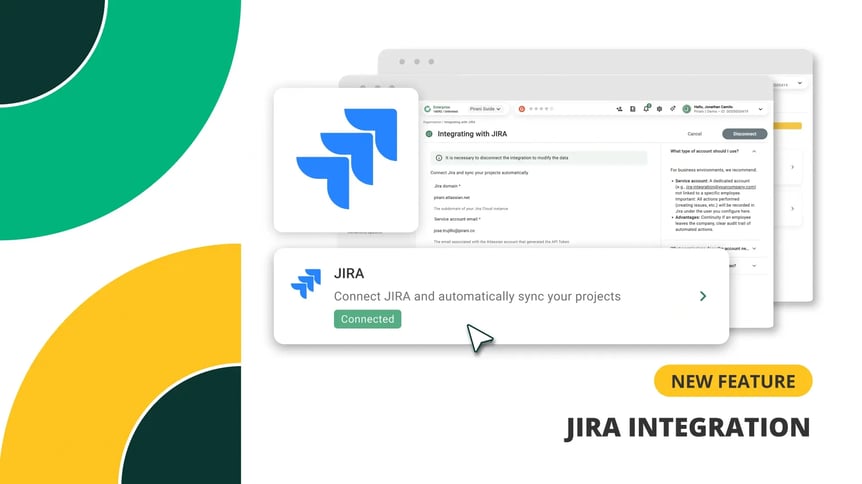
What is Jira and why is it important to integrate it?
Jira is a widely used ticket management platform that records activities, incidents, tasks, and workflows for technical or software development teams. Its flexibility allows for creating and tracking tickets that range from application errors to service requests or maintenance tasks.
In many organizations, Jira becomes the primary record of daily technical operations. However, this information rarely reflects automatically in risk or compliance systems.
The traditional challenge: isolated information and manual evidence
Before this integration, most organizations faced inefficient workflows:
- The incident or event was managed in Pirani.
- Technical activities were executed and documented in Jira.
- Users had to download information from Jira.
- Then manually attach files in Pirani as evidence.
This process was not only slow and error-prone but also violated a core principle of effective risk management: continuous and reliable traceability.
What does the Pirani-Jira integration bring?
The integration between Pirani and Jira is designed to streamline communication without disrupting the existing processes in each system:
Its main advantage is that Pirani and Jira can exchange information continuously and in real time.
This means that:
Technical operations in Jira become evidence directly linked to the incident in Pirani.
Risk teams can view and associate tickets from Jira without leaving the management platform.
How does this integration work in practice?
The integration revolves around two main mechanisms:
1. Creating Jira tickets from Pirani
From the events or incidents module in Pirani, a user can:
- Select the Jira project to connect.
- Define the ticket type (e.g., bug, task, incident).
- Enter the ticket title and description.
Once confirmed, the ticket is automatically created in Jira and linked to the corresponding event or incident in Pirani.
This workflow is especially useful when an incident has no technical actions started yet and technical evidence needs to be generated from scratch.
2. Associating existing Jira tickets
When technical activities are already documented in Jira, the integration allows users to:
- Browse the list of available tickets directly from Pirani.
- Select one or more relevant tickets.
- Associate them with an event or incident as linked evidence.
This eliminates the need to download files, copy descriptions, or repeat documentation efforts.
What does not change with this integration?
When Jira is integrated with Pirani:
- Associated tickets do not change the status of the event in Pirani.
- Incident management continues to be handled in Pirani as the official system of record.
- Jira remains the place where actual technical actions are documented.
This ensures that incident governance remains under the control of the risk management system while Jira provides the necessary contextual technical evidence.
Key benefits for your organization
Integrating Jira with Pirani offers tangible advantages for technical, security, compliance, and risk teams:
Complete traceability
View all technical evidence linked to an incident without manual processes.
Reduced operational effort
Users no longer need to download files or copy information manually.
Improved user experience
Streamlines working with technical evidence directly from Jira.
Consolidated visibility
Risk owners can access technical actions without leaving Pirani.
A step toward real process automation
Beyond efficiency gains, this integration represents an evolution in how organizations approach risk management: as a continuous flow between operations and risk, rather than separate silos.
By removing manual barriers between Jira and Pirani, companies gain:
- Data governance
- Faster response times
- Audit-ready traceability
- Reduced human error
In contexts where every piece of evidence matters for decision-making, this integration is a key component for modern, effective risk management.
Requirements and availability
The Jira integration:
- Is available for ORM, Compliance, ISMS, and Audit management systems.
- Available from the Starter plan onward.
- Requires users to have the appropriate permissions to create or associate Jira tickets within Pirani.
Are you already using the Jira integration?
Discover here how to integrate Pirani with Jira in our Help Center modules.
Try it now!
Don’t have the Starter plan yet? Schedule a demo with our sales team!

Process Filters: Key Information Across All Your Systems

How Director Accountability Will Shape African Regulation in 2026

Why Third-Party Risk Will Be the First Domino to Fall in 2026

Calculated Fields in Pirani: Accurate, Automated Data
2026: The Year Operational Risk Becomes a Survival Discipline
No Comments Yet
Let us know what you think