

Most guides to ISO 31000 are written as if every organisation has a dedicated risk department, a mature data infrastructure, and a board that already speaks the language of risk. For the majority of financial institutions in West Africa, none of those assumptions hold.
The good news: ISO 31000 was specifically designed to avoid them. The standard is non-prescriptive by intent — it gives you principles and lets you adapt. The problem is that most implementation guides ignore that flexibility and translate the standard into processes that only work at scale.
This article is the other guide. The one for the risk manager who is also the compliance officer, the one whose team is two people, and the one whose biggest challenge is not understanding ISO 31000 — it is making it work on Monday morning.

What ISO 31000 Actually Requires (Less Than You Think)
Before getting practical, it helps to be clear about what ISO 31000 does and does not require.
It does not require a specific organisational structure. It does not require a particular software tool. It does not require certification — unlike ISO 27001, there is no external audit that produces a certificate. What it requires, at its core, is that risk management be integrated into how your organisation makes decisions, that it be proportionate to your context, and that it improve continuously over time.
Those three requirements sound abstract. But they have a direct practical implication for small teams: you do not need to implement everything at once. You need to implement the right things first.
The 4 Steps That Work for Small Teams
Step 1 — Establish context before you build anything
The most common mistake in ISO 31000 implementations is jumping straight to risk identification — building a risk register before anyone has agreed on what the organisation is trying to achieve or what its risk appetite looks like.
ISO 31000 calls this "establishing the context," and it is the step most teams skip because it feels like strategy work, not risk work. It is both. Before you list a single risk, you need clear answers to three questions: What are our strategic objectives for the next 12–24 months? What would prevent us from achieving them? And how much uncertainty is our leadership willing to accept in pursuit of those objectives?
These answers do not need to come from a formal workshop. They can come from three conversations — with the CEO, the board chair, and the head of operations. Write down what you hear. That document is your context. Everything else builds on it.
Step 2 — Build a risk register that is actually usable
A risk register only works if the people who need to use it actually open it. Most risk registers fail not because they are technically wrong, but because they are too complex to maintain with limited time and too abstract to be useful in real decisions.
For a small team, the register should have five columns and nothing more to start: the risk, the cause, the potential impact, the current control, and the owner. No scores, no weighted matrices, no colour-coded dashboards — not yet. Those come later, once the habit of using the register is established.
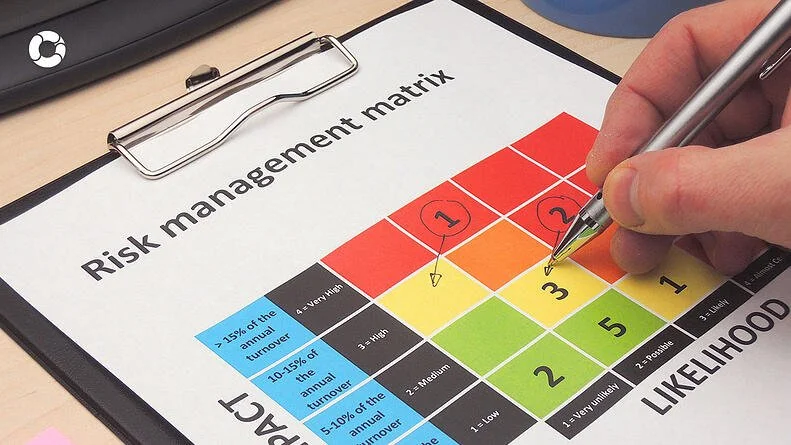
Pirani's free Risk Matrix template includes a risk register and rating section — a practical starting point for small teams that need structure without complexity
Step 3 — Define your risk appetite in one page
Risk appetite is the concept that most risk teams understand intellectually and almost none have documented formally. Yet it is the single most important output of an ISO 31000 implementation, because it is what connects risk management to strategic decisions.
You do not need a 20-page risk appetite statement. You need one page that answers: for each major risk category relevant to our business, what level of exposure is acceptable before we escalate to leadership? That page, approved by the board, transforms risk management from a reporting exercise into a decision-making tool.
As Pirani's Risk Management Study 2026: Africa Chapter found, the primary organisational challenge for African institutions is not identifying risks — it is embedding risk into everyday decision-making. A documented, board-approved risk appetite is the mechanism that creates that connection.

Step 4 — Close the loop with a quarterly review
ISO 31000 requires continual improvement. For a small team, that does not mean a monthly committee meeting with a 40-slide deck. It means a 60-minute quarterly review that answers four questions: Which risks materialised this quarter? Which controls failed or underperformed? What new risks have emerged? Does our risk appetite still reflect our strategic reality?
That review, documented and shared with leadership, is your evidence of a functioning framework. It is also what regulators — including the Bank of Ghana and the South African Prudential Authority — are increasingly asking to see: not just that a framework exists, but that it is actively maintained and connected to governance.
The One Trap to Avoid
The most dangerous moment in an ISO 31000 implementation is when it starts working. Teams that see early results often respond by adding complexity — more risk categories, more scoring layers, more reporting formats. The framework grows faster than the team's capacity to maintain it, and within two cycles it has become the thing it was meant to replace: a document that nobody looks at.
Pirani's Risk Management Study 2026: Africa Chapter is clear on this: the gap between having a framework and making it work is not technical. It is cultural and structural. The organisations that sustain effective risk management are those that keep their frameworks proportionate to their capacity — and grow them deliberately, not reactively.
ISO 31000's flexibility is a feature, not a gap. Use it.
Ready to Go Deeper?
If you want to go deeper on frameworks in the African context — with live examples and practical application — join the next session of the Pirani Risk Management School. This month's topic is risk management frameworks applied to emerging markets. Every third Wednesday of the month, free.
Or if you are ready to see how Pirani supports ISO 31000 implementation from day one: Book a demo →


What is COSO ERM? A Practical Guide for Financial Institutions
3 tips to identify risks
Africa’s New Regulatory Horizon: Risk Management in 2025

ISO 27032, the standard focused on cybersecurity
AI in Risk Management: Can You Trust the Output?

No Comments Yet
Let us know what you think