

For years, risk management across much of Africa was shaped by a single priority: compliance.
Meeting regulatory requirements, aligning with minimum supervisory standards, and demonstrating adherence to international frameworks were the core objectives.
That focus made sense in a context where financial systems were still consolidating, and regulatory capacity was uneven. But as Africa becomes more integrated into global financial, technological, and supply chain ecosystems, that model is no longer sufficient.
By 2026, risk management in Africa is undergoing a fundamental transformation: from compliance-driven to resilience-driven.
This shift is not theoretical. It is being driven by regulators, regional bodies, and international standard-setters responding to real operational shocks—cyber incidents, payment system failures, climate disruptions, and third-party dependencies—that increasingly threaten systemic stability.
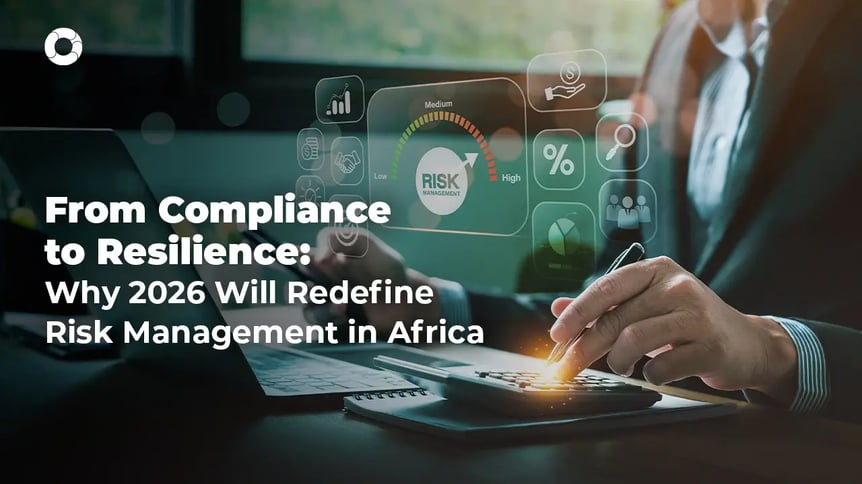
Compliance is no longer enough in a connected risk landscape
Traditional compliance-based risk management focuses on meeting defined rules and controls. It assumes that risk can be managed by adhering to known requirements and reporting incidents after they occur.
But Africa’s risk landscape in 2026 is defined by interconnection and volatility.
Digital financial services, cross-border payments, fintech ecosystems, mobile money platforms, and regional trade initiatives have expanded rapidly. At the same time, infrastructure gaps, cyber maturity asymmetries, and reliance on external technology providers have increased exposure to operational disruption.
Regulators are responding by shifting their attention away from static compliance toward demonstrated operational resilience—the ability of institutions to continue delivering critical services during disruption, not just recover afterward.
This evolution mirrors global supervisory thinking articulated by bodies such as the Basel Committee on Banking Supervision, which has emphasized resilience and operational continuity as pillars of financial stability
Africa is no longer on the periphery of this conversation. It is increasingly at its center.
Operational resilience becomes a supervisory priority
Across the continent, regulators are strengthening expectations around operational risk, business continuity, and technology resilience, particularly in the financial sector.
Central banks and supervisory authorities are embedding resilience concepts into prudential guidance, cybersecurity frameworks, and payment system oversight. The focus is moving toward identifying critical services, understanding operational dependencies, and testing responses to severe but plausible scenarios.
This trend is visible in guidance issued by institutions such as the South African Reserve Bank, which has emphasized operational resilience and cyber preparedness as essential to safeguarding financial stability
It is also reflected in the growing attention paid to payment system resilience under the African Continental Free Trade Area (AfCFTA) and initiatives like the Pan-African Payment and Settlement System (PAPSS), where operational failures could have cross-border and systemic consequences
In this context, resilience is no longer an advanced concept reserved for mature markets. It is becoming a baseline expectation.
The rise of ecosystem risk and third-party dependency
One of the most significant risk management challenges facing African institutions in 2026 is ecosystem risk.
Banks, mobile money operators, insurers, and fintechs increasingly depend on cloud providers, telecom infrastructure, payment processors, and software vendors—many of them located outside the continent. While these partnerships enable scale and innovation, they also introduce concentration and dependency risks that traditional compliance frameworks were never designed to manage.
Regulators are beginning to scrutinize how institutions oversee these relationships, moving beyond initial due diligence toward continuous monitoring, contractual control, and exit planning. This aligns with global supervisory guidance on third-party risk management, which emphasizes that accountability cannot be outsourced.
For African organizations, this represents a major shift. Managing risk now requires visibility beyond organizational boundaries and into extended operational ecosystems.
Cyber risk and financial stability are converging
Cyber risk is another area where the compliance-to-resilience transition is most visible.
As digital financial services expand across Africa, cyber incidents increasingly have the potential to disrupt access to payments, savings, credit, and remittances at scale. This elevates cyber risk from a technical issue to a financial stability concern.
Regional and national cybersecurity strategies reflect this shift, emphasizing incident readiness, coordination, and resilience rather than perimeter defense alone. The African Union’s Convention on Cyber Security and Personal Data Protection provides a continental framework, but regulators are increasingly focused on how institutions operationalize cyber resilience in practice
In 2026, the key supervisory question is no longer whether cyber controls exist, but whether organizations can maintain critical operations while under attack.
Why 2026 is a turning point for risk management in Africa
What makes 2026 different is not a single regulation or initiative. It is the convergence of forces.
Digitalization is accelerating faster than institutional risk maturity. Cross-border integration is increasing faster than regulatory harmonization. External shocks—geopolitical, technological, climatic—are becoming more frequent and more severe.
In this environment, risk management defined purely by compliance becomes reactive and fragile. Resilience-based risk management, by contrast, acknowledges uncertainty and designs for it.
This does not mean abandoning compliance. It means building on it—using regulatory requirements as a foundation for a more adaptive, operationally grounded approach to risk.
For African organizations, the shift from compliance to resilience represents both a challenge and an opportunity.
Those that continue to view risk management as a reporting obligation may find themselves unprepared for operational shocks with systemic consequences. Those that embrace resilience as a strategic capability can strengthen trust, protect continuity, and support sustainable growth in increasingly complex markets.
2026 will not redefine risk management in Africa by adding more rules.
It will redefine it by changing what regulators—and markets—expect risk management to deliver.
Resilience, not compliance alone, will be the measure of success.


The Silent Risk of 2026: Weak Risk Culture Drives Regulatory Findings

South Africa & Ghana: The Continent’s Regulatory Laboratories

Operational Resilience: The Next Frontier in Risk Management

2026: The Year Operational Risk Becomes a Survival Discipline
Africa’s New Regulatory Horizon: Risk Management in 2025

Comments (1)