
by Risk Management School on 31 de March de 2026
In this session, Isabela Campo walks us through the essentials of a Risk Management Framework (RMF) and what organizations need to know to identify, assess, and manage risks effectively. 
- What is a RMF
- Key components of a RMF
- Benefits of a RMF
- 9 Most Important RMF
- Differences Between Frameworks, Certifications, and Policies.
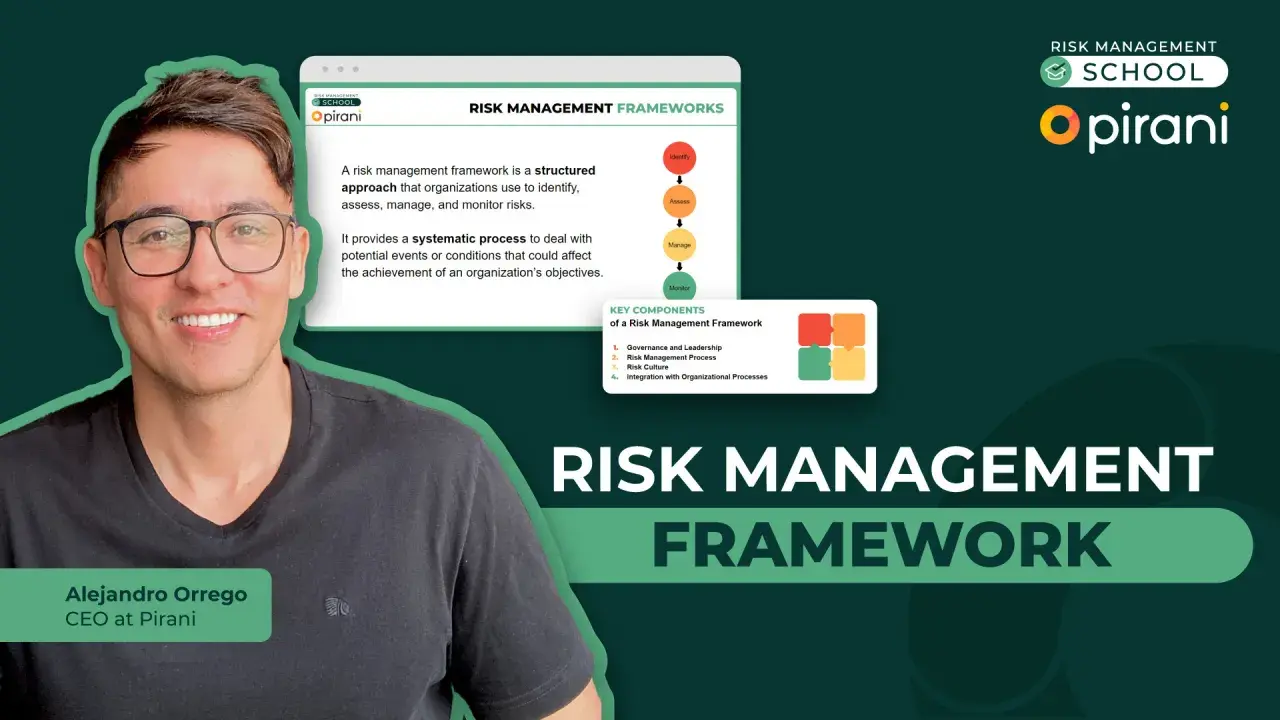
A risk management framework is a structured approach that organizations use to identify, assess, manage, and monitor risks.
It provides a systematic process to deal with potential events or conditions that could affect the achievement of an organization’s objectives.
A robust risk management framework helps ensure that risks are properly managed and mitigated, and opportunities are identified and maximized.
Key components of a Risk Management Framework
- Governance and Leadership
- Risk Management Process
- Risk Culture
- Integration with Organizational Processes
Benefits of a Risk Management Framework
- Enhanced Decision Making: Provides a basis for making informed decisions about risks and opportunities.
- Improved Performance: Helps achieve objectives by addressing risks proactively.
- Regulatory Compliance: Ensures compliance with legal and regulatory requirements.
- Resource Optimization: Allocates resources efficiently by prioritizing risk treatments.
- Resilience and Sustainability: Enhances the organization’s ability to respond to and recover from adverse events.
9 MOST IMPORTANT RISK MANAGEMENT FRAMEWORKS
- ISO 31000
- COSO ERM
- NIST RMF
- ITIL
- COBIT
- OCTAVE
- FAIR
- PMBOK
- PRINCE2
1. ISO 31000
(International Organization for Standardization)
- Overview: ISO 31000 provides guidelines on managing risk faced by organizations. It is not industry-specific and can be applied to any organization.
- Principles:
- Integrated
- Structured and comprehensive
- Customized
- Inclusive
- Dynamic
- Best available information
- Human and cultural factors
- Continual improvement
-
Last version: 2018
ISO 31050: 2023
2. COSO ERM
(Committee of Sponsoring Organizations Enterprise Risk Management Framework)
- Overview: COSO ERM provides a comprehensive approach to risk management, integrating it with strategy and performance.
- Components:
- Governance and Culture
- Strategy and Objective-Setting
- Performance
- Review and Revision
- Information, Communication, and Reporting
- Last version: 2017
3. NIST Risk Management Framework
(National Institute of Standards and Technology)
- Overview: NIST RMF provides a structured process for integrating security and risk management activities into the system development life cycle.
- Steps:
- Prepare
- Categorize
- Select
- Implement
- Assess
- Authorize
- Monitor
-
Last version: SP 800-53 Controls and SP 800-53B Control Baselines
Resources for Implementers,Updated June 14, 2024
4. ITIL
(Information Technology Infrastructure Library)
- Overview: The Information Technology Infrastructure Library (ITIL) is a set of practices and a framework for IT activities such as IT service management (ITSM) and IT asset management (ITAM) that focus on aligning IT services with the needs of the business.
Certification in ITIL is only available to individuals and not organizations. Since 2021, the ITIL trademark has been owned by PeopleCert.
- Risk Management Aspects:
- Risk identification
- Risk analysis
- Risk evaluation
- Risk treatment
- Risk monitoring and review
- Communication and consultation
- Last version: ITIL v4 - 2019
5. COBIT
(Control Objectives for Information and Related Technologies)
- Overview: COBIT is a framework created by ISACA for information technology (IT) management and IT governance.
The framework is business focused and defines a set of generic processes for the management of IT, with each process defined together with process inputs and outputs, key process-activities, process objectives, performance measures and an elementary maturity model.
- Risk Management Domains:
- Align, Plan and Organize
- Build, Acquire and Implement
- Deliver, Service and Support
- Monitor, Evaluate and Assess
- Last version: 2019
6. OCTAVE
(Operationally Critical Threat, Asset, and Vulnerability Evaluation)
- Overview: OCTAVE is a risk-based strategic assessment and planning technique for cybersecurity.
- Phases:
- Build asset-based threat profiles
- Identify infrastructure vulnerabilities
- Develop security strategy and plans
- Last version: 2005
7. FAIR
(Factor Analysis of Information Risk)
- Overview: FAIR is a model for understanding, analyzing, and quantifying information risk in financial terms.
- Components:
- Risk
- Loss Event Frequency
- Vulnerability
- Threat Event Frequency
- Contact Frequency
- Probability of Action
- Loss Magnitude
8. PMBOK
(Project Management Body of Knowledge)
- Overview: PMBOK is a set of standard terminology and guidelines (a body of knowledge) for project management.
This document results from work overseen by the Project Management Institute (PMI).
- Risk Management Processes:
- Plan Risk Management
- Identify Risks
- Perform Qualitative Risk Analysis
- Perform Quantitative Risk Analysis
- Plan Risk Responses
- Implement Risk Responses
- Monitor Risks
- Last version: 2021 PMBOK Guide, Seventh Edition
9. PRINCE2
(Projects IN Controlled Environments)
- Overview: PRINCE2 is a project management methodology that emphasizes dividing projects into manageable and controllable stages.
- PRINCE2 is a process-based method for effective project management, and this qualification will equip you with the fundamental skills needed to be a successful project manager
- Risk Management Approach:
- Identify
- Assess
- Plan
- Implement
- Communicate
- Last version: 2023 PRINCE2 7th Edition

How to achieve effective communication in risk management
Main risk management strategies
No Comments Yet
Let us know what you think