

In Anti-Money Laundering (AML) systems, segmentation is not just an operational component. It is the foundation upon which transaction monitoring, alert calibration, and comprehensive risk management are built. When segmentation is not methodologically supported, the risk is not technical—it is regulatory. For this reason, model selection should not rely on historical practices or subjective criteria. It must be backed by statistical evidence, structural coherence, and traceable documentation.
The Pirani AML Segmentation Module has been designed with this objective: transforming segmentation into a process that is defensible before auditors and regulators.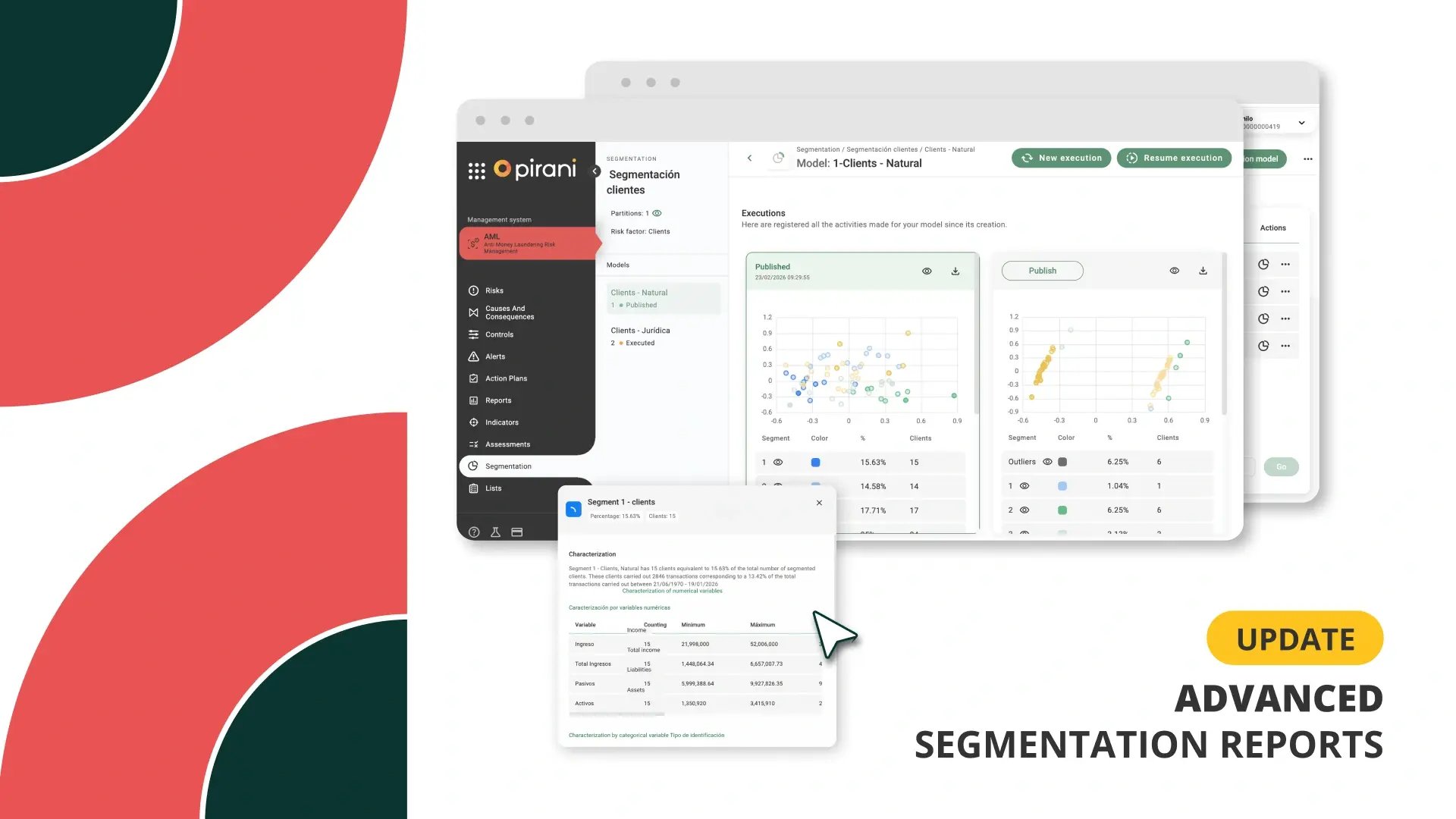
Tabla de contenido
A Structured Approach from the Start
Populated Data Evaluation
Before running any model, the system evaluates:
- Completeness of the variables
- Robustness of the uploaded data
- Consistency of the recorded information
This analysis ensures that segmentation is built on statistically sound information, reducing the risk of decisions based on incomplete data. Data quality ceases to be an assumption and becomes a measurable criterion.
Transparency in Data Preparation
The module automatically executes the necessary stages for statistical processing:
- Data cleaning and validation
- Transformations
- Normalization (when applicable)
- Technical adjustments prior to modeling
Each stage is visible and documentable, ensuring:
- Methodological traceability
- Support for internal audits
- Evidence for regulatory requirements
Segmentation stops operating as a “black box” and becomes a verifiable process.
Pirani Copilot: Evidence-Based Recommendations
One of the module’s main differentiators is the integration of Pirani Copilot, an intelligent assistant that automatically analyzes the structure of the uploaded data. Copilot evaluates:
- Statistical distribution
- Density and dispersion
- Data geometry (PCA)
- Size of the uploaded data
- Natural clustering patterns
Based on this analysis, it recommends the most suitable model among:
- K-Means
- Two-Stage (Bietápico)
- DBSCAN
The recommendation is not based on technical complexity but on structural coherence. The final decision remains with the user, ensuring methodological control and alignment with the organization’s risk strategy.
Objective Model Configuration and Comparison
The module allows users to:
- Define and adjust hyperparameters
- Execute multiple runs
- Compare alternative configurations
- Analyze results by client type (e.g., natural persons and legal entities)
It also generates quality indicators such as:
- Silhouette (internal cohesion)
- Davies–Bouldin (group separation)
- Calinski–Harabasz (overall balance)
These indicators enable users to evaluate the statistical consistency of each run and provide technical justification for the final model selection.
Designed for Regulated Environments
The Pirani AML Segmentation Module meets the needs of organizations requiring:
- Analytical governance
- Structured documentation
- Comparability across runs
- Control over methodological decisions
- Technical support for audits and regulatory reviews
More than executing algorithms, the system provides a comprehensive framework to manage segmentation as a strategic asset within the AML compliance ecosystem.
Why Choose Pirani for Your AML Segmentation
Because it does more than group data. It enables you to:
- Technically justify every decision before auditors and regulators
- Reduce methodological risk, avoiding subjective decisions
- Avoid unnecessary overengineering, using only what the model requires
- Document the entire process, from data upload to final execution
- Defend your model, ensuring alignment with the organization’s risk strategy
In an increasingly demanding regulatory environment, segmentation cannot be intuitive. It must be strategic and defensible.
Do you want to strengthen the governance of your segmentation?
Discover how to segment your AML+ system using our Help Center modules.
Try it now!
Don’t have the Enterprise plan? Schedule a demo with our Sales team!


Calculated Fields in Pirani: Accurate, Automated Data

Pirani and Jira Integration: Connecting Operations and Risk Management
Strengthen Your AML System by Validating International Lists
.webp)
Quantitative Risk Assessment: More Precision, Less Subjectivity

GRC Simplified: A Strategic Approach

No Comments Yet
Let us know what you think